AI - How it is changing Construction/Design industry

AI in the style of Zaha Hadid
THE COMING OF A.I.
Since ChatGPT arrived in 2022, AI has been rarely out of the news. Most of us have dabbled from the search engine assistance to asking ChatGPT to help with part of a report or seen Thomas Heatherwick’s Humanise Campaign which used AI to create images of brutalist landmarks.
AI companies are starting to make some big claims in the construction & design industry – QBIQ claiming their AI on an office fit out scheme can lead to 73% reduction in design-related expenses and 60% faster cycle time from inquiry to signed lease.
THE THREE ‘A’s AND RELEVANT SECTORS
AI is a broad term covering many strands from all areas of our lives. Autodesk identifies the main advantages of AI for construction and design industry as the three A’s
• Automation
• Analysis
• Augmentation
So, what sectors offer the most advantages?
• Feasibility & Schematic analysis – enhanced analysis of sites, quickly produced initial visuals and initial options
• Optimising Designs – generating floorplans, improving layouts & reducing steel required in structural designs
• Enhanced CGI – Enable Clients/Stakeholders to see more design before built with quicker/cheaper renders and VR
• Improved Project Management & Collaboration – AI assisting with managing programmes, and teams
• More sophisticated Building Management Systems – from management of heating to AV systems
COMMENTS AND LINKS TO EXISTING A.I. OFFERINGS
Below are a series of useful links to and comments on current AI offerings within these sectors.
1 Feasibility & Schematic analysis
There are a variety of site analysis AI tools such as
– ARK
– Conix
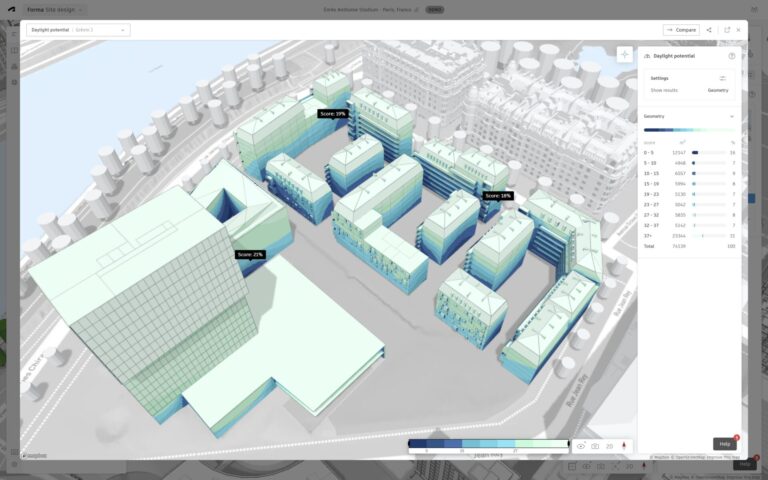
Daylight analysis in Autodesk Forma
2 Optimising Designs
There are an increasing number of floor plan generating and optimising AI tools. Although compliance is a major issue.
– Maket – Residential floor plans
– Laiout – Floor plan generator
– Finch – Optimising proposals
3 Domestic/Individuals – plans and interior design/images
Design flats/house layouts and providing renders and interior design ideas for the domestic market;
– HomedesignsAI – Layouts and renders
– AI House – Styling and layouts
4 Bolt on to existing CAD/BIM software
All the main CAD software companies (Autodesk (Revit), Bentleys (MicroStation) and Nemetschek (Vectorworks) are developing their own AI products.
Autodesk talk of neural CAD as the next stage of development with Autodesk Forma. Some of tasks carried out by AI listed by Bentley Systems & Autodesk are;
- Generative AI for Design: Bentley is leveraging generative AI in its engineering applications to propose alternative and potentially superior designs, which can lead to more efficient use of materials and energy.
- Automated Drawing Production: AI is used to accelerate the production of design drawings by automating mundane tasks like annotation, labelling and sheeting, optimizing them for legibility and aesthetics.
- Site Analysis and options use AI to optimize site designs
- The Revit add-in understands plain language instructions, bypassing the need for technical scripts or complex syntax.
5 Enhanced CGI – Image generation
CGI has been around for some time and AI has enhanced the capability including VR / walk throughs etc. Applications split into two main types;
5.1 Generated from words (text to image model)- i.e. you type in some word such as ‘Bond villain lair by sea at sunset’ and you get an output of a suitably villainous Californian dream Baddy house.
– Stable Diffusion
– Leonardo – Used to produce all the images on this page
– Midjorney
5.2 Generated from actual proposal plans – sophisticated rendering
– AI for Architecture & Design | Gendo AI
6 Improved Project management & Collaboration
There are a number of platforms offering assistance with project management and work flows – often developed in other industries and brought across to Construction. Examples are – Miro— Best for visual project mapping with AI
– Smartsheet— Best for automating workflows
– Procore— Best for project collaboration
7 Building Management Systems/AV etc
There are numerous development in BMS and also AV systems for example
– Bosch
– AV trends

Bond villain lair
FUTURE WINDS OF CHANGE AND LOTS OF QUESTIONS
Aside from the existential repercussion of the AI revolution – which remain debated amongst optimists and realists – the practical considerations for the near future within the design industries are emerging.
The above list of AI offerings are those that are currently available to unrestricted markets, and although some firms have a head start the landscape is rapidly changing. Critically, the future value of such tools lies heavily in the intellectual property of their data. Larger architecture and design companies are already developing their own systems where learning is maintained internally to ensure their competitive advantage, and this will likely be a trend across all industries.
Some of the immediate changes and concerns are;
At project level
Can we trust AI to provide good information? Most of us have experienced the ‘eccentric’ moments of ChatGPT. Will we start by treating AI output as that of an enthusiastic officer junior, which requires careful checking? There are some tricky issues;
- Copyright issues – if we use AI output for design are we exposing ourselves and clients to copyright claims from original data generators?
- PI Insurance – when AI makes an error where – between software provider and user – will liability fall and how is this determined? What will the attitude be of courts, more critically of Insurance companies be?
- Clients and Contracts – Will companies have to declare where they are using AI? Will AI be excluded from certain areas in the procurement process and how will this be done?
At industry level
At present AI is mainly offering optimising and efficiency tools that enable one person to be more productive. This seems inevitably to lead to fewer people required to both design and manage projects. The potential for ‘efficiencies’ in work force is clear, but will AI be sufficiently competitive to ensure that potential profits are not filtered through from design industry professionals to their Silicon Valley developers? And of course what are the implications in job security and renumeration for the design community ?
Some sectors certainly feel more vulnerable – particularly where repetitive tasks and information can be extracted from 3D models (Revit etc)
– QS /costing
– Structural
– Compliance / CDM/Building control
Design teams will likely reduce in size with either project managers or architects using AI to augment compliance/repetitive/ specialist roles.
Larger client organisations may take more design in house augmented by AI, working up proposals to a high level of detail and using professionals for finalising and securing with PII. Design and Build almost certainly looks set for a further bolster, and the tendency to go ‘larger’ where set up costs and the need for access to powerful tools leaves smaller operators at a disadvantage.
Client and regulatory requirements
Recent technological advances such as CAD, BIM and general computer use, have been accompanied by increased demand in information on projects at development stages. Revisiting visual and compliance information required for a planning application in the pre-CAD 1990s is a useful indicator of likely future requirements. The increasingly complex compliance framework will likely be encouraged by the abilities of AI to demand extended information. Clients will also expect higher levels of design representation to be included within standard fee proposals, and these will also likely be demanded by LPAs on even the smallest projects.

AI does a country house for an international footballer
On a positive note, perhaps activists will be empowered to also check claims of insensitive proposals or to more easily put forward alternative schemes in the community interest.
Structural change in procurement
AECOM recently paid $390mill for the acquisition an Consigli, a Norwegian AI company touting itself as ‘The Autonomous Engineer’ powering automating space/unit analysis & MEP design. The company claims its technology gives reductions in engineering design time of up to 90%. What is pertinent is that whereas AI design/optimisation companies were previously bought by software houses, scales of efficiency mean that giant consultants such as AECOM can enter the growing battleground with ownership of their own AI.
The advantages for large construction companies are arguably even greater. With project margins under pressure and clients demanding real-time data-driven insights, owning a targeted AI layer could offer a critical differentiator.
AND FINALLY …
At times if may be difficult not to feel like an eighteenth century artisan staring at a brave new world of machinery that can chew through output with a smattering of human operators. The power of AI is beyond dispute.
Whether AI results more in an arms race of ability to demand, produce and interpret increased levels of information, or whether it genuinely powers our ability to build more efficiently (and beautifully?!), the effect on the players and participants in the design and procurement process will be extensive.
